
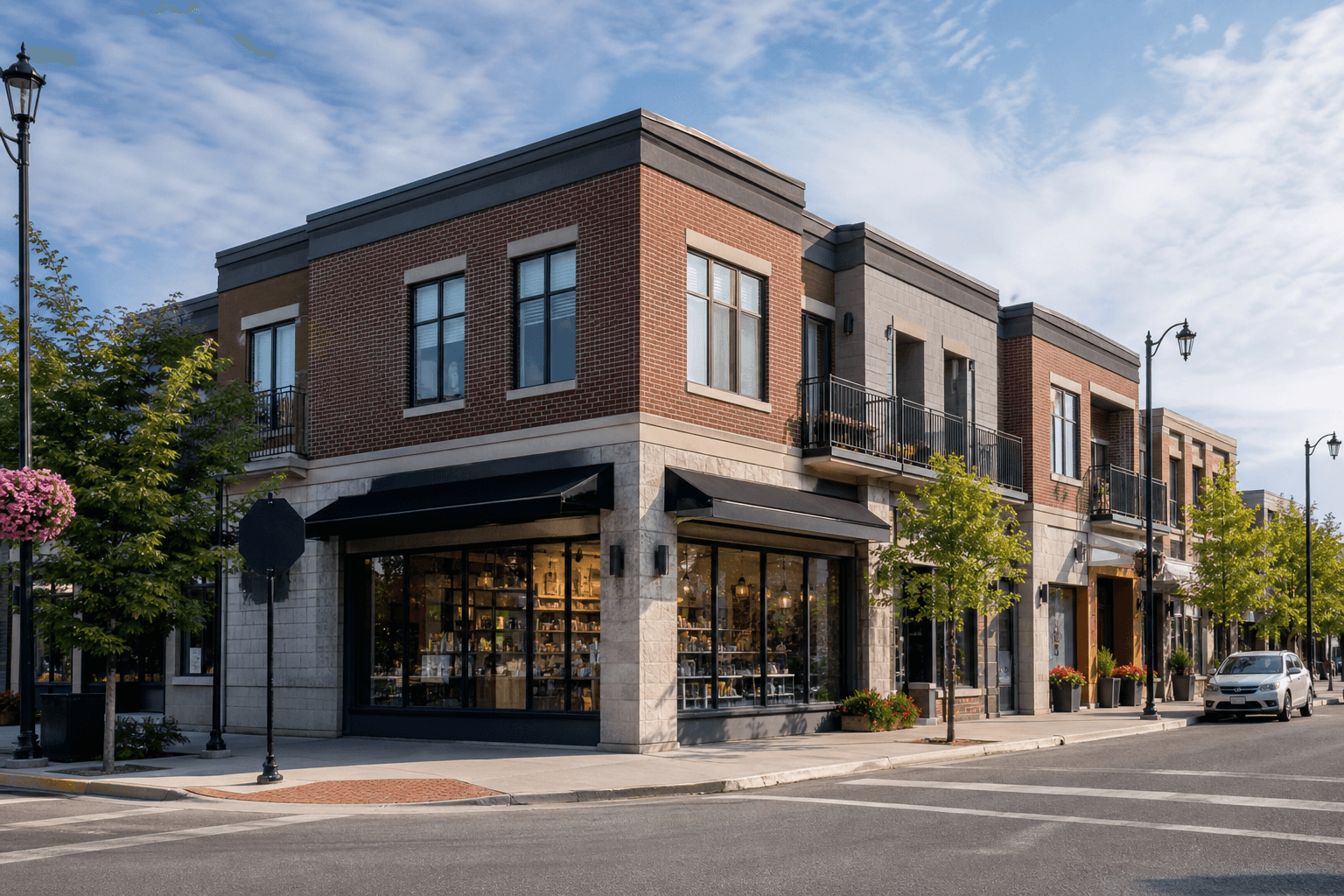
Mixed-use property financing is not automatically a residential mortgage or a commercial mortgage. The appropriate route depends on the division between residential and non-residential space, how the property is occupied, whether its uses are permitted, how income is generated, and what you plan to do with it.
A storefront with apartments above may require a different financing discussion from a single-family home, even when the residential portion is substantial. Before comparing rates or requesting approval, establish what the property is, how it operates, and which part will drive the lender's analysis.
What Counts as a Mixed-Use Property?
A mixed-use property combines residential space with commercial or other non-residential space in the same building or development. Examples include a retail unit with apartments above, a building containing offices and residential units, or a property where the owner operates a business alongside a residence.
The label alone does not determine the financing structure. A lender may consider the size and purpose of each portion, whether the commercial space is occupied, the strength of any leases, the property's condition, and whether you plan to live there, operate a business, rent it out, or renovate it.
The key question is not simply, “Can I get a mortgage?” It is, “How will this property and its income be assessed?”
Compare the Main Financing Routes

This comparison is general education, not a prediction of eligibility or available terms. The same property could be assessed differently depending on its use, documentation, borrower profile, and lender policy.
| Route to investigate | When it may be relevant | Key tradeoff |
|---|---|---|
| Residential financing | The property has a substantial residential component and limited commercial use that fits the lender's criteria. | The analysis may be more familiar, but the lender still needs to accept the property's mixed use. |
| Commercial mortgage financing | Business use, commercial space, leases, operating income, or investment objectives are central to the property. | The lender may require more detailed property, income, and operating information. |
| Project-specific or program-based financing | The plan involves construction, conversion, rental housing, or another project with specialized eligibility requirements. | Availability depends on the specific program, property, project, and borrower. |
For a broader explanation of the distinction, review the factors behind commercial mortgage financing. The practical decision is to identify which route deserves investigation, then confirm the details with a qualified professional.
Residential Financing
A residential approach may be worth investigating when the residential portion is dominant, the commercial use is limited, and the property's configuration fits a lender's residential criteria. A buyer purchasing a building with a primary residence and a relatively small, established commercial area may want to ask whether residential financing is possible.
The potential advantage is a more familiar residential analysis. The limitation is that “mostly residential” is not a guaranteed category. The lender may still need details about the commercial area, access, leases, renovations, insurance, and permitted use.
Do not base the decision on residential square footage alone. Commercial activity, income source, property design, and intended use can be equally important.
Commercial Mortgage Financing
A commercial mortgage may warrant investigation when the commercial portion is substantial, the property is primarily an investment, business operations are central to the purchase, or lease and operating income will be important to repayment.
Commercial underwriting may involve a closer look at the property, lease quality and terms, operating expenses, vacancy risk, borrower experience, and the business or investment plan. The exact information and terms vary by lender. Do not assume that a commercial label automatically means a particular down payment, rate, amortization period, or loan-to-value limit.
A useful comparison should focus on lender fit, documentation, property analysis, communication, and alternatives if the first route does not work. You can also review how to compare commercial mortgage brokers for property financing.
Project-Specific or Program-Based Financing
A purchase or refinance is not the same as a construction or conversion project. If you plan to convert a non-residential building into rental housing, build additional units, or complete substantial redevelopment, a specialized program may be relevant.
For example, CMHC's Apartment Construction Loan Program describes financing for building or converting non-residential buildings into sustainable rental housing. Its published terms distinguish between residential and non-residential loan-to-cost treatment, including up to 100% loan to cost for residential space and up to 75% for non-residential space under that program. Those details apply to the stated program and its eligibility rules, not to ordinary mixed-use purchases or every borrower. Review the official CMHC program information and confirm whether your project qualifies.
Property Details That Can Change the Analysis
Prepare a clear description of the property before discussing financing. Important details may include:
- Space allocation: Estimate the residential and commercial portions and describe each use.
- Current and planned use: Explain whether the property will be owner-occupied, rented, operated as a business, renovated, or changed after purchase.
- Occupancy: Identify vacant, owner-occupied, tenant-occupied, and business areas.
- Lease status: Note written leases, remaining terms, vacancies, and rent schedules.
- Condition and improvements: Describe deferred maintenance, planned renovations, construction, and changes that could affect use or value.
- Access and layout: Explain whether residential and commercial areas have separate entrances, services, or operating arrangements.
- Income profile: Distinguish established rent or business income from projections dependent on future occupancy or improvements.
These facts help a mortgage professional determine which questions to take to lenders. They do not guarantee that a lender will accept the property or count every income source in the same way.
Confirm Zoning and Permitted Use Early
Zoning and permitted use should be checked before you rely on current income or plan a change. A commercial use that appears suitable may not be permitted in the same form, and a proposed residential conversion may require municipal confirmation, permits, or other professional review.
Ask the municipality or an appropriate local professional to confirm permitted uses, occupancy limits, conversion requirements, and relevant restrictions. Keep written information available for the financing discussion. A lender, appraiser, lawyer, or insurer may each examine different aspects of the property's legal and physical status.
Borrower and Income Factors to Prepare
The property is only one side of the application. A lender may also consider intended use, personal income, business income, existing debts, credit profile, assets, experience, and repayment plan. An owner-occupant, investor, and business operator may present the same property in very different ways.
Separate established income from projected income. Existing leases and documented operating results may be reviewed differently from expected rent after renovations, a proposed new tenant, or a business that has not opened. Ask which income sources can be considered, what evidence is needed, and whether expenses or vacancies affect the analysis.
If you are self-employed or applying through a corporation, organize personal and business records. Business gross revenue should not be assumed to receive the same treatment as personal qualifying income.
Common Information to Gather Before Applying
Requirements vary, but the following can make the initial discussion more productive:
- Purchase agreement, current ownership details, or proposed refinance amount.
- Property address, floor plan, approximate square footage, and residential-commercial split.
- Current and planned uses, occupancy details, vacancy information, and renovation plans.
- Written leases, rent schedules, operating statements, and business projections where relevant.
- Zoning, permitted-use, or municipal information already obtained.
- Personal income records, business financial statements, tax information, and proof of assets where applicable.
- Existing mortgage, credit, debt, and other payment details.
- Information about the intended repayment plan, such as long-term ownership, sale, refinance, or operating income.
This is a preparation checklist, not a guaranteed lender document list. The professional handling your inquiry can identify what is needed after understanding the property and transaction.
Questions to Ask a Mortgage Professional
- Which portion of the property is likely to drive the financing analysis?
- Could this property be considered for residential financing, commercial mortgage financing, or both?
- How will residential rent, commercial rent, and business income be evaluated?
- What zoning, lease, occupancy, appraisal, or operating documents should be confirmed first?
- Does owner-occupation change the financing discussion?
- How will planned renovations, conversion, vacancy, or projected income affect the analysis?
- Which assumptions require confirmation from a municipality, lawyer, accountant, appraiser, or insurer?
- If the first route does not fit, what other financing categories should be investigated?
A Mixed-Use Financing Decision Checklist
- Describe the property: Record the building type, areas, access, condition, and occupancy.
- Confirm permitted use: Verify zoning and investigate whether planned use or renovation is allowed.
- Document income: Gather leases, rent schedules, operating records, and clearly labelled projections.
- Clarify your purpose: State whether you will live there, operate a business, rent it, renovate it, or combine these plans.
- Organize borrower finances: Prepare personal, business, asset, debt, and tax information.
- Compare routes: Ask whether residential, commercial, or specialized project financing should be investigated.
- Confirm assumptions: Request a clear explanation of how the property, income, and intended use will be assessed.
Frequently Asked Questions
Can a mixed-use property qualify for a residential mortgage?
It may be possible when the residential component is substantial and the commercial use fits the lender's criteria. The property still needs to be reviewed as a whole, including layout, use, income, occupancy, and permitted status.
When might a mixed-use property require commercial mortgage financing?
Commercial financing may be more appropriate when business operations, commercial space, leases, investment income, or non-residential use is central to the transaction. A professional must determine which route fits the facts.
What documents are commonly requested?
Commonly requested information can include purchase or ownership documents, property details, leases, rent schedules, operating records, income and tax information, debt details, zoning information, and renovation plans.
Why does zoning matter?
Zoning helps establish whether current or planned residential and commercial uses are permitted. Financing based on an unconfirmed use may rely on an assumption requiring further municipal or professional review.
Can projected rental or business income be used?
Projected income may be discussed, but it should not be treated as equivalent to established income without confirmation. Ask how projections, vacancies, leases, operating expenses, and supporting evidence will be evaluated.
Conclusion
The strongest starting point for mixed-use property financing is the property's real-world use, not a label chosen before the details are reviewed. Identify the residential-commercial split, confirm permitted use, document occupancy and income, and compare residential, commercial, and specialized routes without assuming a particular rate, approval, or loan structure.
Amarpreet Bhui is a Mississauga-based licensed mortgage broker serving Southern Ontario, offering commercial mortgage guidance and support from pre-approval through closing. After organizing your property and borrower information, request tailored financing guidance from Amarpreet Bhui.
Last updated October 5, 2026