
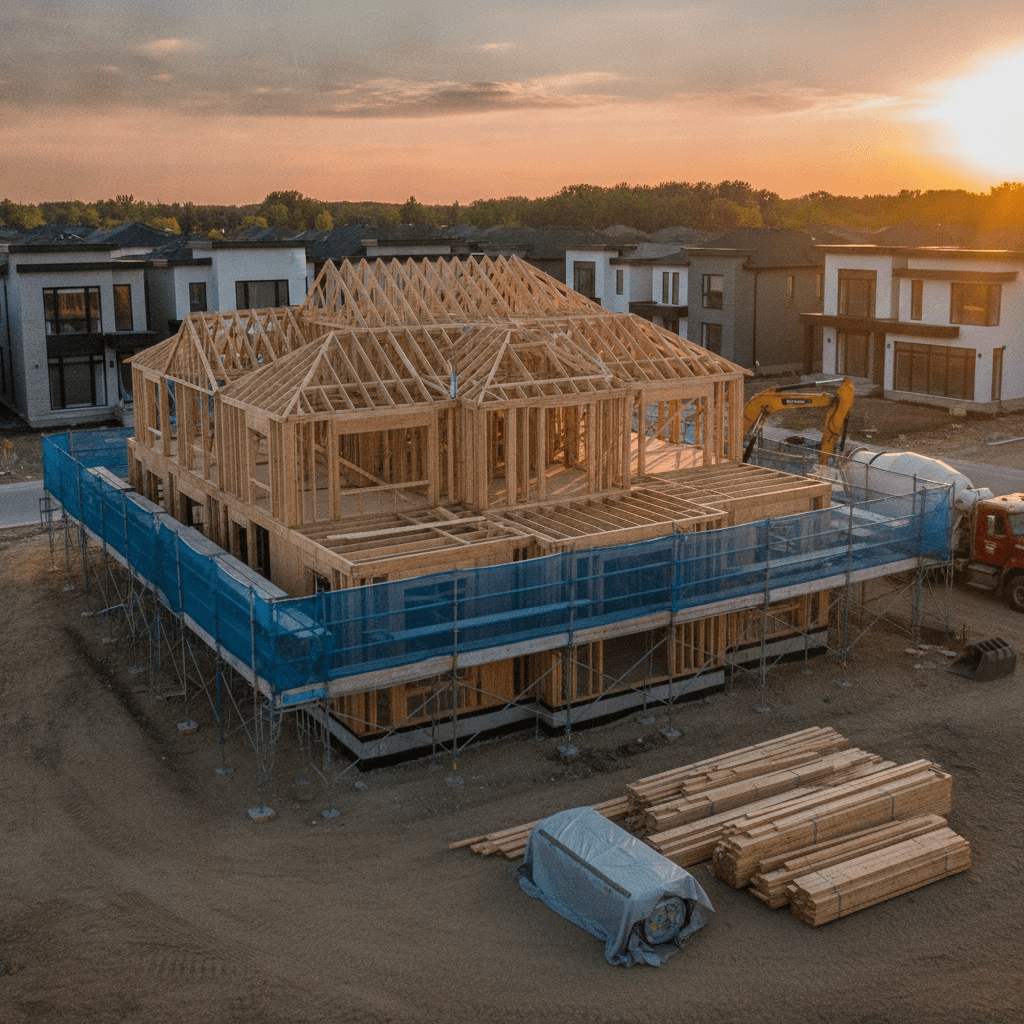
A custom home construction loan is short-term financing that funds a new build in stages and converts to a long-term mortgage when the home is finished. It advances money through progress draws tied to milestones. For Mississauga borrowers, it keeps cash flowing during construction and protects you from paying interest on funds you haven’t used yet.
By MiiGrowth — Amarpreet Bhui • Last updated: 2026-07-05
Overview
A custom home construction loan finances your build in phases, then converts to a regular mortgage once complete. You draw funds at milestones (foundation, framing, enclosure, finishes, completion), pay interest only on drawn amounts, and lock in long-term financing at occupancy.
Building a one-of-a-kind home is exciting—and complex. This complete guide explains how custom home construction loans work for Mississauga borrowers and how MiiGrowth supports you from blueprint to move‑in.
- Clear definitions: construction loan vs. regular mortgage vs. HELOC
- Step-by-step process with draw stages and inspections
- Local insights for Mississauga timelines, permits, and seasonality
- Best practices for budgets, contingencies, and builder contracts
- Tools you can use now: Instant Eligibility, Mortgage & Affordability Calculators, Mortgage Guides
What Is a Custom Home Construction Loan?
A custom home construction loan is short-term, milestone-based financing that releases funds in draws as your home is built. When construction is complete, the loan converts (or is refinanced) into a standard amortizing mortgage, streamlining the transition to long-term payments.
Unlike a standard purchase mortgage that funds everything on closing day, construction financing pays as work is completed. Most lenders structure four to six draws anchored to site prep, foundation, framing, lock‑up (windows/roof), interior rough‑ins, and final completion.
In our experience supporting Southern Ontario builds, clients value two features most: interest-only payments on money actually used during the build, and a single underwriting path that moves you from construction to a regular mortgage at occupancy.
- Term: Typically 6–18 months covering build time plus a buffer.
- Draws: 4–6 progress advances based on inspections or appraisals.
- Holdbacks: Portions retained until lien periods expire and work passes inspection.
- Conversion: Roll into a long-term mortgage at completion (same lender) or refinance with best-available terms (rate-shopped).
- Cash management: Interest applies only to funds drawn, not total approved amount.
Here’s the thing: successful builds pair the right loan structure with a realistic budget and builder contract. We connect those dots so financing supports—not slows—your schedule.
Why a Construction Loan Matters for Custom Builds
Construction loans match cash flow to your build schedule, reduce interest by funding only what you’ve used, and simplify closing by converting to a long-term mortgage. They also create discipline through inspections, holdbacks, and builder accountability.
Without proper construction financing, owners often rely on personal savings or random credit lines. That increases risk, creates timing gaps, and leads to stressful vendor delays. A purpose-built loan keeps trades moving and aligns everyone to verified milestones.
- Cash-timing fit: Most projects need capital every 4–8 weeks. Draws meet that cadence.
- Safeguards: Inspections, appraisals, and holdbacks verify quality and completion.
- Predictability: A planned 12-month build window with 4–6 draws reduces surprises.
- Exit clarity: A defined path to your long-term mortgage avoids last-minute scrambles.
Consider a Mississauga family replacing an aging bungalow with a modern two‑story. Their loan funded site demo and foundation first, then framing six weeks later. Because interest applied only to drawn funds, their carrying costs stayed manageable while crews accelerated the schedule.
How a Custom Home Construction Loan Works (Step-by-Step)
The construction-loan journey runs from pre-approval to conversion: plan your budget, get approved, schedule draws against milestones, pass inspections, and roll into a long-term mortgage at completion. Clear paperwork and builder coordination keep funds on time.
Step 1: Plan and Pre‑Approve
- Use MiiGrowth’s Affordability Calculator to size your build within comfort.
- Confirm land status (owned vs. to be purchased), zoning, and basic permits path.
- Draft a realistic budget with 10–15% contingency for unknowns.
- Secure preliminary drawings and a builder estimate or fixed‑price contract.
Pre‑approval sets expectations. Many builds target 9–14 months from shovel to keys, with weather adding variance in winter.
Step 2: Full Application and Underwriting
- Submit income, credit, down payment/equity, land documents, plans, specifications, and builder credentials.
- Provide a schedule of draws aligned to work stages (e.g., foundation, framing, lock‑up, drywall, completion).
- Expect an as‑complete appraisal and progress‑inspection framework.
We’ve found that clean, labeled PDFs and a one‑page draw summary reduce back‑and‑forth and accelerate approvals.
Step 3: Close the Construction Facility
- Legal review ensures lien holdbacks and title insurance are in place.
- Initial advance often funds land payoff or early-stage materials and trades.
- Set communication cadence with your builder and inspector early.
Clarity here pays off later. Everyone should know who requests draws, who signs, and how quickly inspections occur.
Step 4: Draws and Inspections During the Build
- Submit draw requests tied to finished milestones with photos/invoices.
- Inspections validate percentage complete; lender advances net of any holdbacks.
- Typical cadence: every 4–8 weeks; lock‑up is a common mid‑project trigger.
Most lenders schedule 4–6 total draws. Aligning trades to these triggers keeps materials flowing and reduces delay claims.
Step 5: Completion and Conversion
- Final inspection confirms occupancy readiness and closed permits.
- The loan converts to a long‑term mortgage (or you refinance to a better fit).
- Provide completion photos, certificates, and final invoices to release holdbacks.
At conversion, MiiGrowth rate‑shops across lenders for the best long‑term fit, matching your goals for payment stability and flexibility.
Types of Construction Financing (And When to Use Each)
Three paths commonly fund custom builds: a single-close construction‑to‑permanent loan, a two‑close construction loan plus separate mortgage, or a HELOC paired with savings for small projects. Choose based on complexity, timing, and your tolerance for re‑underwriting.
There’s no single “right” structure. The best option depends on your plans, builder agreement, and equity in land. Here’s a practical breakdown.
Single-Close (Construction-to-Permanent)
- One approval and closing, one set of legal work, automatic conversion to long‑term mortgage.
- Predictable path; often simpler for first‑time builders.
- Useful when you want to lock in a clear exit up front.
Two-Close (Construction Then Separate Mortgage)
- Close construction now; refinance into the best market rate later.
- More flexibility to switch lenders or products after the build.
- Re‑underwriting required; documents will be updated at completion.
HELOC + Savings (Selective Scope)
- Suitable for additions or phased renovations rather than ground‑up builds.
- Fast access to funds; interest applies to what you use.
- Less structure than a formal construction facility; monitor scope creep.
| Feature | Construction Loan | Standard Mortgage | HELOC |
|---|---|---|---|
| Funding timing | 4–6 progress draws | All funds at closing | On-demand revolving |
| Payments during build | Interest-only on amounts drawn | N/A (no build phase) | Interest-only, variable |
| Inspections/holdbacks | Yes, per stage | Appraisal only | None |
| Exit to long-term | Convert or refinance | N/A | Refinance if desired |
| Best for | Ground-up custom builds | Move-in-ready purchases | Additions or renos |
How Lenders Qualify You (And How to Get Ready)
Lenders assess income stability, credit, project budget, plans/specs, builder experience, land status, and exit strategy. Packaging documents cleanly and aligning your draw schedule to real milestones speeds approvals and keeps funds flowing during construction.
Self‑employed? MiiGrowth actively supports flexible documentation and explains how to present retained earnings, add‑backs, or contract histories responsibly. Strong files move faster.
- Income and credit: Steady history or well‑documented variable income.
- Project budget: Transparent line items with 10–15% contingency.
- Plans/specs: Scopes that leave little to interpretation reduce change orders.
- Builder: Track record, references, license/insurance, and signed contract.
- Land: Deed, value, and any servicing or environmental notes.
- Appraisal/inspections: As‑complete value and progress checks.
- Exit plan: Clear conversion to long‑term mortgage or refinance.
We encourage clients to run Instant Eligibility first, then refine with our Mortgage and Affordability Calculators. That sequence surfaces constraints early and trims weeks off underwriting.
Rates, Terms, and Cash-Flow Considerations
Expect a short build term with interest-only payments on drawn funds and a defined path to a long-term mortgage at completion. Cash-flow modeling with contingencies and realistic draw timing keeps your build on schedule and stress in check.
Construction facilities are designed for speed and oversight, not long‑term amortization. Owners who plan for 4–6 draws, seasonal scheduling, and a 10–15% cushion navigate surprises without halting work.
- Term window: Most projects target 6–18 months, aligned to permits and weather.
- Interest‑only: Carrying costs scale with actual usage, not approval limit.
- Conversion timing: Prepare your long‑term mortgage 30–60 days before occupancy.
- Cash‑flow map: Plan materials deposits and inspections to minimize downtime.
Pro tip: keep a simple draw tracker (date requested, stage, invoices attached, inspector scheduled, funded date). A one‑page log prevents missed steps and keeps the site humming.
Best Practices for Smooth Construction Financing
Document clearly, align draws to real milestones, maintain a 10–15% contingency, and communicate weekly with your builder. Upfront rigor shortens approvals and keeps your schedule intact when weather or supply delays appear.
- Contracts: Fixed‑price with allowances reduce scope creep; time‑and‑materials needs extra oversight.
- Milestones: Tie draws to verifiable stages (e.g., “windows installed and roof shingled”).
- Photos: Date‑stamped progress photos cut inspection questions by half.
- Permits: Track submissions and inspections; list what’s open/closed in your draw log.
- Insurance: Builder’s risk and liability aligned to lender requirements.
- Contingency: Minimum 10% for hidden conditions or supply swings.
What most people don’t realize: aligning your draw schedule to supplier lead‑times (windows, HVAC, cabinetry) reduces stand‑downs and keeps trades sequenced cleanly.
Tools and Resources You Can Use Today
Start with Instant Eligibility, then model payments with the Mortgage Calculator and capacity with the Affordability Calculator. Use MiiGrowth’s step‑by‑step Mortgage Guides to prepare documents and build a lender‑ready file in days, not weeks.
- Instant Eligibility: Quick screening to gauge approval potential before you commit to plans.
- Mortgage Calculator: Model carry during the build and payments after conversion.
- Affordability Calculator: Right‑size your design to your budget and cash flow.
- Mortgage Guides: Plain‑English checklists for faster, cleaner underwriting.
For helpful local context on planning a purchase journey, see this Mississauga home‑buying overview and this focused pre‑construction guide. For mortgage fundamentals presented simply, this mortgage basics explainer offers another perspective.

Common Pitfalls and How to Avoid Them
Most issues stem from weak scopes, optimistic timelines, and undocumented changes. Lock your scope, maintain a contingency, track change orders, and align inspections with real completion to avoid funding gaps and schedule slippage.
- Scope creep: Additions without budget offsets drain contingency.
- Permit timing: Assuming approvals arrive early can halt trades; build float into schedules.
- Change orders: No signed change order, no work—protects budget and timeline.
- Documentation gaps: Missing invoices/photos stall draws for days.
- Communication: Weekly check‑ins prevent small issues becoming costly rework.
We help clients script a five‑minute weekly agenda: progress vs. schedule, open permits, upcoming inspections, supplier lead‑times, and next draw date. Short, consistent updates reduce surprises dramatically.
Real‑World Examples From Mississauga Clients
Successful custom builds share patterns: clean documentation, realistic draw timing, and disciplined changes. These three Mississauga scenarios show how structure and communication kept projects moving and budgets intact.
Scenario 1: Self‑Employed Borrower, New Two‑Story Build
- Challenge: Variable income and retained earnings.
- Approach: We packaged two years of financials, contracts-in‑hand, and a builder resume to support stability.
- Result: 5‑draw schedule approved; windows delivered on time thanks to early deposit planning.
Takeaway: thoughtful self‑employed packaging shortens underwriting and prevents mid‑build scrutiny.
Scenario 2: Teardown and Rebuild With Tight Timeline
- Challenge: Winter foundation pour and inspection windows.
- Approach: We padded the schedule by four weeks and synchronized inspections with trade availability.
- Result: Framing advanced before deep freeze; lock‑up achieved in line with the second draw.
Takeaway: seasonal padding and milestone alignment protect momentum.
Scenario 3: Addition + Major Renovation Using HELOC
- Challenge: Scope suitable for HELOC but prone to creep.
- Approach: We set a not‑to‑exceed and weekly change‑order checks.
- Result: Project finished within 8% of the original plan.
Takeaway: HELOCs are powerful for phased work—discipline keeps them on track.
Local Insights for Mississauga Custom Builds
Plan for seasonal weather, realistic permit timing, and supplier lead‑times common in the GTA. Align draw requests with inspector availability and builder sequencing to avoid downtime and keep your crews moving.
Local considerations for Mississauga
- Expect winter and early‑spring weather to affect foundation and exterior work; add buffer days to hit lock‑up.
- Coordinate inspections around peak permit windows; book early to protect draw timing.
- Track supplier queues for windows, HVAC, and cabinetry; align these with your draw schedule to minimize stand‑downs.

Let’s Map Your Build in 20 Minutes
A quick consult clarifies eligibility, the best construction-loan path, and your draw schedule. We’ll outline documents, timelines, and a plan to convert to your long‑term mortgage—so your build stays funded and on schedule.
Book a brief conversation with MiiGrowth. We’ll run Instant Eligibility, scope your draw plan, and share a lender‑ready checklist you can use with your builder this week.
Frequently Asked Questions
These quick answers cover common questions about custom home construction loans, from timelines and draw schedules to self‑employed documentation and using a HELOC for additions.
How long does a custom home construction loan last?
Most facilities run 6–18 months, matching your build window plus a small buffer. You’ll make interest‑only payments during construction and then convert to a long‑term mortgage or refinance at completion.
How many draws are typical?
Four to six draws are common. Milestones often include foundation, framing, lock‑up, drywall/rough‑ins, and completion. Each draw is supported by an inspection or progress appraisal before funds are advanced.
Can self‑employed borrowers qualify?
Yes. With thoughtful packaging—financial statements, contracts-in‑hand, and a strong builder file—self‑employed clients can secure construction financing. MiiGrowth helps present variable income and add‑backs responsibly.
Is a HELOC enough for a custom build?
HELOCs work well for additions or phased renovations. For ground‑up builds with multiple trades and inspections, a formal construction facility with draw stages and holdbacks provides better oversight and cash‑flow control.
Key Takeaways
Construction loans fund builds in stages, charge interest on drawn amounts, and convert to a long-term mortgage at completion. Clear documents, realistic contingencies, and tight builder coordination keep projects moving and budgets intact.
- Use 4–6 draw milestones aligned to real completion.
- Maintain a 10–15% contingency for the unexpected.
- Plan conversion 30–60 days before occupancy.
- Package documents clearly to speed underwriting.
Conclusion
A well-structured construction loan is the backbone of a successful custom build. When milestones, inspections, and conversion are mapped early, your project stays funded, on schedule, and ready to transition into a comfortable long‑term mortgage.
Ready to start? MiiGrowth guides Mississauga clients from pre‑approval to keys—with Instant Eligibility, calculators, and mortgage guides built for clarity. Let’s tailor your construction‑to‑permanent path and get your timeline locked in.
Last updated July 5, 2026